
The Most Valuable Topps Baseball Cards of 1971, March 2026
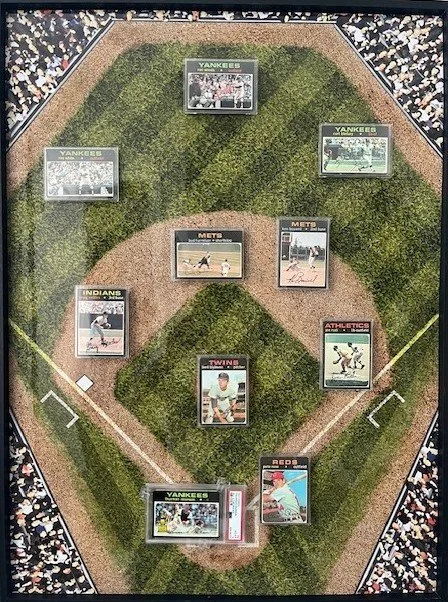
The 1971 Topps Baseball set is one of the most striking releases of the vintage era, as Topps abandoned the safer white frames for jet-black borders that chip easily and make high-grade examples notoriously tough. The base set contains 752 cards, issued across six series, with the late high numbers scarcer since less were printed, adding real chase to building a complete run. Subsets include League Leaders, Playoff Highlights, and World Series Highlights. Card fronts feature lowercase player name/position with the team name in caps while the backs debut a small black-and-white player photo with 1970 and career stats.
Notably, the 1971 set is the first to include in-game actions shots for individual player cards, creating a whole new sense of dynamism to the small subset of players cards that were used action shots (there were action shots before, but they were limited to special cards, such as those representing the World Series).
Among the most notable cards are rookie issues of Steve Garvey, Bert Blyleven, and the multi-player rookie of Dusty Baker/Don Baylor, alongside stars like Clemente, Mays, Aaron, Ryan, Bench, Jackson, Rose, Banks, and Munson that anchor the checklist. Condition sensitivity (edge chipping, centering) and the high-number scarcity drive much of the set’s value profile today.
Here at Remarkable Artworks we think value is in the eye of the beholder and the greatest value you can get from your cards is to appreciate them in our unique display solution. If you want to learn more about the display, click below.
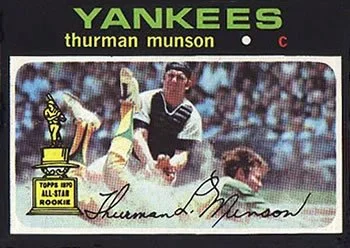
#5 Thurman Munson - $199,999
We know that the rookie cards of Hall of Famers tend to be the most valuable. So how is it that the 1971 card for Thurman Munson, which is not his rookie card and who is not in the Baseball Hall of Fame, is the most valuable 1971 card?
The reason has to do with what was so unique about the 1971 set as it was the first time that Topps included in-game action shots for individual player cards. While there were a few other good in-game action shots that, especially of pitchers in their windup, this card stands out for being the fist card to catch a moment-in-time, gritty play at the plate. Add to it the fact that Munson was a very good player for the most famous team who tragically died young, and you get one of the most iconic cards ever produced. It ranks in just about everyone’s top 10 favorite cards of all-time (including ours).
Note: the is the price paid for a mint condition card as there are no know gem mint versions of this card
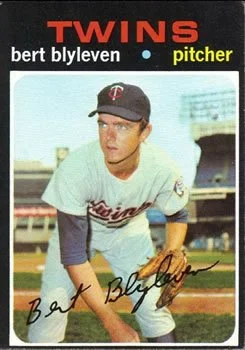
#26 Bert Blyleven - $138,000
Blyleven was a very good pitcher. He pitched for 22 years and struck out 3,701 batters, which is top 10 all-time. He was a 2-time All-Star and a 2-time world series champion. Yet he was rarely in the Cy Young conversations during his playing days, a sign that he wasn’t considered one of the elite pitchers of his time. However, while it did take him 14 years of eligibility, Bert was ultimately elected into the Baseball Hall of Fame in 2011. This is also his rookie card. So rookie card plus Hall-of-Famer are two important reasons that make this the second most valuable card (as long as it is is pristine condition, the lesser quality versions don’t hold as much value) of 1971.
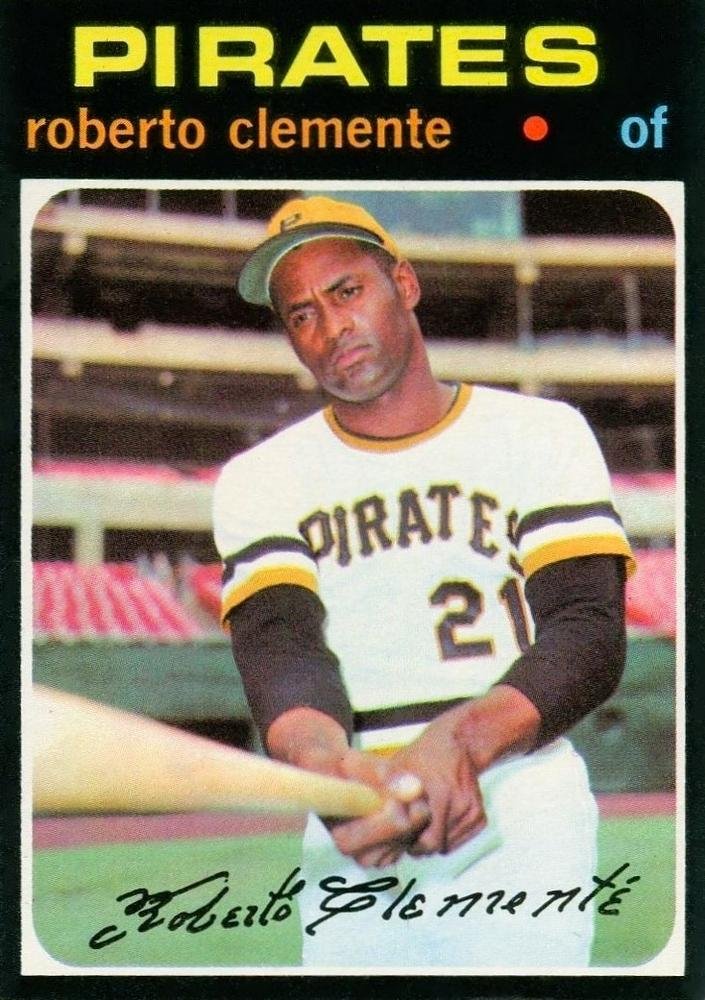
#630 Roberto Clemente - $71,700
One of the most beloved baseball players of all-time, Roberto Clemente cards are amongst the most valuable of any year. Clemente turned 36 in 1971 yet was still at the top of the game as he was 5th in the MVP voting that year. The picture itself is standard-issue, but it’s a Clemente.
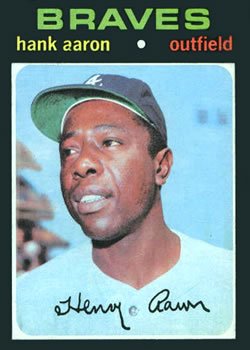
#400 Hank Aaron - $60,000
The all-time home run king still at he top of his game is a recipe for a highly sought-after card. Hammerin’ Hank was still a few years away from breaking Ruth’s career home runs record, but he was 3rd in MVP voting in 1971 and still one of the best players in baseball at the ripe old age of 37.
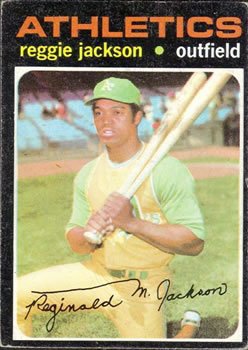
#20 Reggie Jackson - $52,738
If he wasn’t the best baseball player of the 1970’s, he was surely the most famous. We see him here a year before the A’s won the World Series three years in a row (1972-1974) and a few years before he became “Mr. October” when he helped the Yankees to two consecutive World Series titles (1977-1978). Whether you loved him or hated him, you respected him.
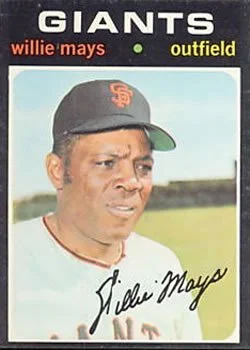
#600 Willie Mays - $48,416
At 40, Mays was in the twilight of his career, but he was still one of the best players in baseball. His Wins Above Replacement was in impressive 6.3 in 1971 as he led the league in walks and on base percentage and stole twenty-three bases while being caught stealing only three times. This would be Mays’ last year with the Giants as he would be traded to the Mets during the 1972 season.
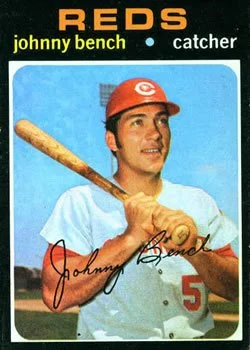
#250 Johnny Bench - $42,000
Bench was at the pinnacle of his career in the early 1970s, although 1971 was a slight down year compared to his MVP seasons of both 1970 and 1972. He did earn National League All-Star honors, his fourth of thirteen straight All-Star appearances, as he was still the best catcher in baseball and the anchor of the emerging Big Red Machine.

#525 Ernie Banks - $41,823
The last card of Banks during his playing career and the end of an era for the Cubs. Banks was 40 in 1971 and played all of his nineteen seasons with the Cubs, yet the Cubs were in such a tough stretch that they never made the playoffs throughout that time.
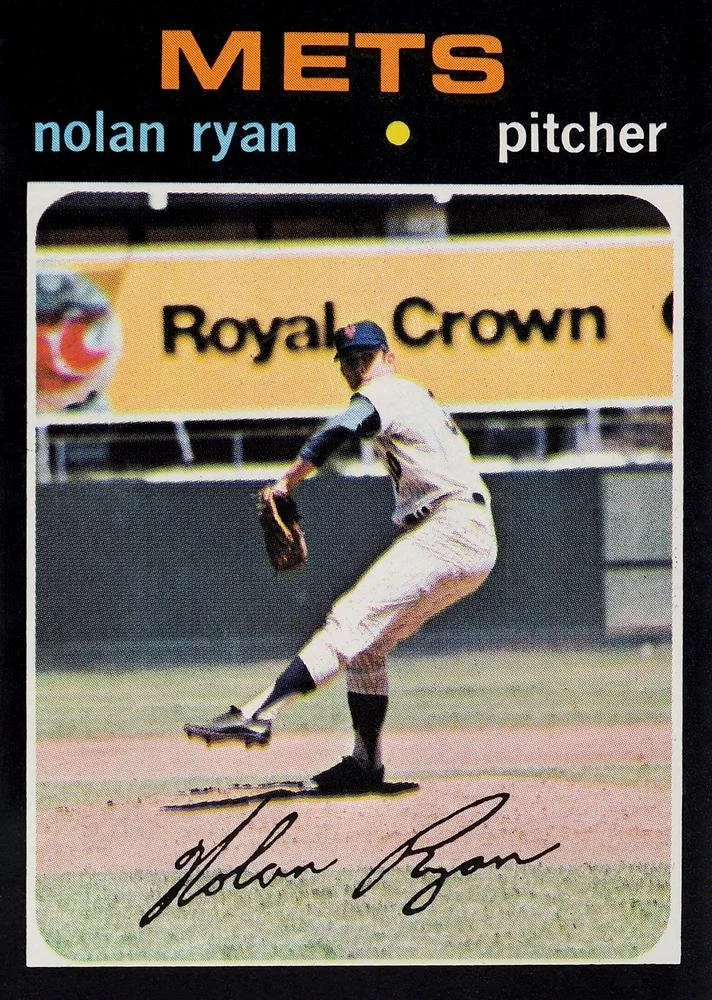
#513 Nolan Ryan - $34,408
While his rookie card is the most valuable, many would argue this is his best card. We see an early-career Ryan, who was still a closer at this point, in the his first in-action shot about to hurl his infamous 100 MPH fastball. It isn’t an accident by the photographer that Ryan’s head is nearly perfectly centered between the “Royal” and “Crown” signage in the background as there are multiple early 1970s cards with similar cheekiness.
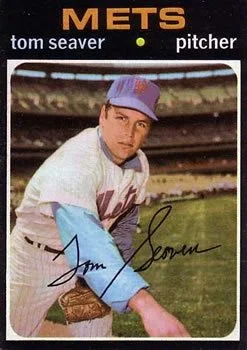
#160 Tom Seaver - $29,250
It is easy to forget that Seaver and Ryan pitched on the same team as Seaver was the star and Ryan was still honing his craft. Seaver was the best pitcher in baseball in the early 1970s, winning the Cy Young in 1969 and 1973 and leading the league in ERA in 1971 and 1972.